
Water Rights: Ensuring Access and Protection

Billions of people still don’t have access to safe water and toilets. Even though we’ve made big improvements, getting clean water is a huge problem around the world. The Department of the Interior in the U.S. manages 338 reservoirs. These hold 245 million acre-feet of water for 31 million people. But, we still face big challenges in making sure everyone can get and protect the water they need.
Water rights are key for survival, dignity, and prosperity. They connect to many laws, like the Riparian Doctrine in the east U.S., and the Prior Appropriation Doctrine in the west. It’s important to understand and manage these laws well to share water fairly.
It’s up to governments to make sure water and sanitation rights are met for everyone. This means helping those who are often left out, like indigenous people or those with less money. By focusing on these issues, we can work towards safe water for all. Let’s explore why water rights matter and how they can help us build a fairer, more sustainable world.
Understanding the Importance of Water Rights
Water rights play a huge role in how we manage water in different areas of the U.S. They involve laws like riparian rights and the prior appropriation doctrine. These rules are key in deciding how water is used and saved for farming, homes, and businesses.
Definition and Types of Water Rights
People or landowners get water rights to use water from a specific place for certain reasons. There are mainly two types: riparian and prior appropriation rights.
Riparian rights are for landowners next to rivers or streams, letting them use water without harming neighbors. Littoral rights are similar but for those by lakes or seas. They help share water fairly and protect the water’s natural condition, a big deal in environmental law today.
The prior appropriation rule is most common out west and follows “first in time, first in right.” The first person to use water from a source gets the rights. But, these rights can be lost if not used for their intended purpose after a while.
Riparian vs. Prior Appropriation Doctrines
The difference between riparian and prior appropriation is important to know. Riparian rights are used in the east where water is plenty. They allow landowners by water like rivers to use it for things like watering crops or drinking.
In the western U.S., they use prior appropriation due to less water. This “first come, first served” rule is vital there. Those who got water rights first have priority. This affects water sharing and has led to agreements like the Colorado River Compact.
Also, under riparian rights, you can’t sell water rights without the land. But prior appropriation allows these rights to be sold or leased by themselves. Federal laws like the Clean Water Act make sure these rules help keep water use sustainable and protect the environment.
History of Water Rights in the United States
Water rights in the United States have a rich history tied to U.S. History and early settlements. Spanish explorers in the 16th century diverted water in California for farming and mining. This began the basis for water rights laws. The Crown owned water under Spanish law, used first for public needs then private ones. This approach set the stage for future water rights laws.
The riparian doctrine grew in Europe, valuing rivers and shifting towards “reasonable use” during the Industrial Revolution. Landowners could use water on their land but didn’t own it. This idea was adopted in the American colonies, shaping early U.S. water rights.
“English water law was simple and undeveloped, with riparian rights held by landowners along streams, limiting conflicts over water use in the American colonies.” – Wilkinson
The Homestead Act of 1862 and the Reclamation Act of 1902 were key during Western Expansion. The Homestead Act gave settlers land needing water for farming. The Reclamation Act helped start large irrigation projects, making water crucial in settling the west.
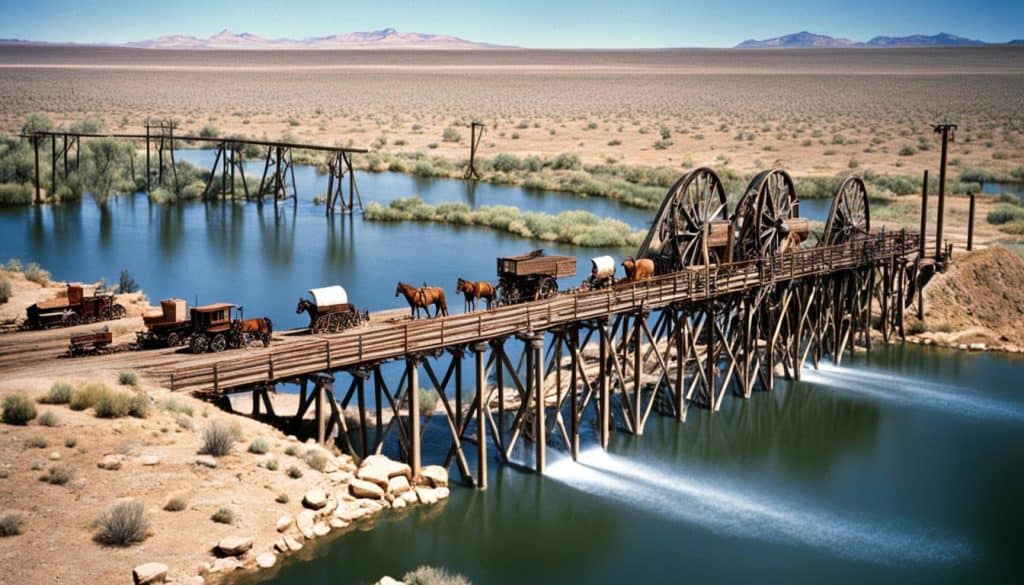
In the 19th century, farms used lots of water, about 80% in the west. But irrigation systems lost water to seepage. In California’s Imperial Valley, nearly one million acre-feet of diverted water became waste in the Salton Sea. This showed the need for better water management.
In the late 20th century, cities struggled with water shortages as populations grew. This led to conflicts like the Klamath River case, where farm water needs clashed with needs to protect aquatic species.
To deal with these conflicts, Congress set up a commission in 1992. Their goal was to review Western water policy and clear up confusion caused by many agencies. This was important for managing water rights as demands and populations increased.
By recent decades, experts predicted big gaps between water supply and demand, especially in drought years. For example, the 1998 California Water Plan update expected a gap of 2.4 to 6.2 million acre-feet by 2020.
Knowing the history of water rights is key. It helps us understand current policies and future management plans. By looking at how water rights have evolved from early settlements to today, we learn about managing this essential resource in modern America.
The Human Right to Water and Sanitation
Having safe drinking water and sanitation is a basic human right. The United Nations General Assembly made this clear on July 28, 2010. They stated that access to clean water and sanitation is vital for enjoying all human rights.
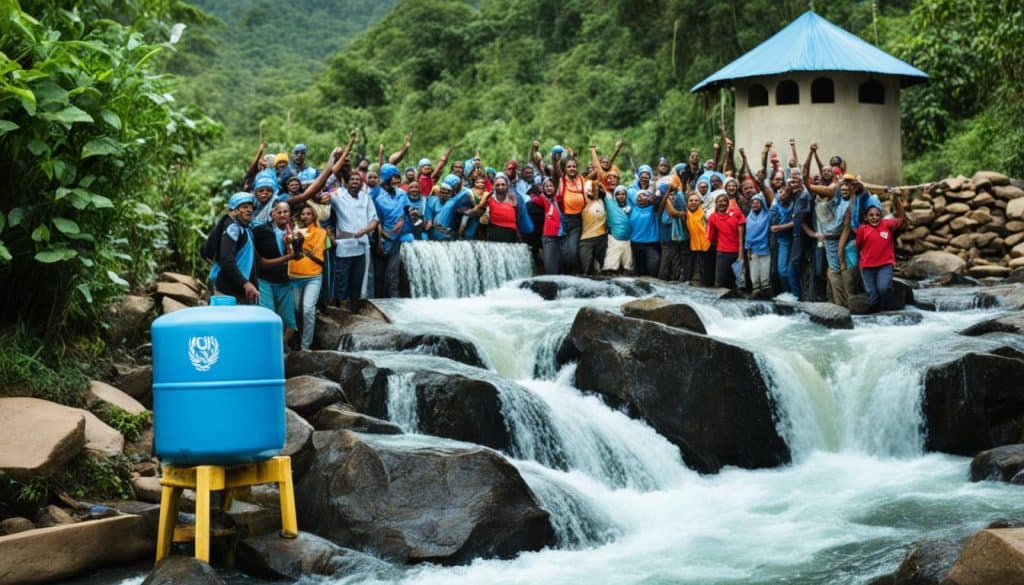
United Nations Recognition
The UN has highlighted the need for good water and sanitation. General Comment No. 15 says that the right to water means having enough safe and affordable water for personal use. This has helped in promoting values such as human dignity and overall health.
“Water and sanitation are an essential part of breaking the cycle of poverty and diseases.” – UN Secretary-General António Guterres
Challenges Faced by Marginalized Groups
People living in poverty often lack clean water and good sanitation. Shockingly, over 2 billion people do not have access to safe drinking water as of 2022. Also, poor water and sanitation impact billions, causing diseases and losing 443 million school days yearly. Solving these issues is key to achieving fairness.
Government’s Role and Human Rights-Based Approaches
Governments must follow human rights-based ways to ensure everyone has access to water and sanitation. For example, Indonesia has programs that focus on gender and social fairness. Using this approach, governments improve water management and include everyone, following principles of participation and equality.
Water Rights and Environmental Law
Water rights and environmental laws are closely linked in the U.S. Federal laws help shape water policies. This often leads to clashes between state and federal government over water management.
Impact of Federal Legislation
The Clean Water Act is key in regulating water pollutants. It seeks to keep the nation’s waters clean and healthy. The aim is to protect water’s chemical, physical, and biological health.
The Department of the Interior plays a big role in water and land management. It works to meet both environmental and human needs through various agencies. Laws like the Clean Water Act guide this work, focusing on water quality and ecosystem health.

Conflicts between State and Federal Authorities
State and federal laws often clash over water rights. States have their own laws, which might conflict with federal rules. For instance, California has its unique water rights system.
In California, riparian rights let landowners use water flowing by their land. But, they can only use it on their property. The “first in time, first in right” policy from the Gold Rush times means those who used water first have the right to it. This often clashes with federal regulations like the Clean Water Act.
During water shortages, California faces more issues. Though riparians have priority, all must share the shortage. The federal mandate for fair water distribution can challenge state rules. This sometimes makes tensions worse.$total>
Grasping these issues is crucial for understanding water rights and environmental law in the U.S.
Conservation Efforts and Resource Management
Responsible water management is key for future generations to have clean, ample water. One key strategy is mitigation banking, which protects wetlands. It supports the environment and helps fish, birds, and communities.
Mitigation Banking and Wetlands Preservation
Mitigation banking helps make up for lost wetland areas due to development. By establishing new wetlands or improving existing ones, this approach balances development with nature conservation. The Sacramento Valley, for example, uses detailed water plans to help save wetlands.
In California, over 1,500 reservoirs store around 40 million acre-feet of water. This storage is critical for keeping managed wetlands watered. Yet, over 80% of the state’s native freshwater fishes are at risk. Mitigation banking aims to improve their survival chances.
State and Local Regulations on Water Conservation
Local and state rules are key in saving water. In the Sacramento Valley, there are 45 urban and 21 agricultural water plans aimed at improving efficiency. Cities aim to cut water use by 20% by 2020, beating previous goals. Starting in 2023, urban areas will also have new daily water use goals, helping conserve water further.
These efforts are central to using water wisely and tackling climate change issues. They help ensure that water is properly used in all areas. They also protect snowpack water, crucial for many native species.