Military Law Revisions: Upholding Justice for Service Members

The heartbeat of our nation’s freedom beats with our soldiers’ bravery. I have seen the dedication of these heroes up close. It shows me how important justice and fairness are in military law. It’s vital that our laws reflect the democracy values they fight to protect.
We try to make military law better because we value and respect our soldiers. The Uniform Code of Military Justice (UCMJ) helps keep order and fairness in the military. But sometimes, it’s not perfect. That’s why we keep improving it, to stay true to our justice principles.
Since 2006, more than 80 important updates have been made to the UCMJ. These changes show Congress’s dedication to keeping military justice strong and fair. Yet, there are still issues that need fixing. Sometimes, it seems like the law is too harsh. We need to fix these problems to keep everyone’s trust.
Key Takeaways
- The UCMJ, enacted by Congress, is the legislative backbone of military discipline.
- Service members can appeal court-martial decisions to the Court of Appeals for the Armed Forces or even to the Supreme Court.
- Military law must balance disciplined forces with federal protections, including the Bill of Rights.
- Congress periodically reviews and revises the UCMJ to align with national values and service member rights.
- Calls for an overhaul of the UCMJ stress the as need for consistency, clarity, and fairness.
Understanding the Posse Comitatus Act: Historical Context and Modern Implications
To grasp the Military-Civil Relations changes, we must first get the Posse Comitatus Act basics. This key law, established in 1878, makes it illegal for Army or Air Force to enforce domestic laws unless allowed by the Constitution or a Congress act. Over time, case law highlighted how infractions happen when Federal Troops undertake tasks meant for civilian law enforcement.
Origins and Purpose of the Posse Comitatus Act
The Posse Comitatus Act came about during the rough Reconstruction period. It was a response to the fear of military overreach, with Federal Troops ruling over the southern states. The Act’s main goal was to enforce a clear line between military and civilian law enforcement. It aimed to keep Military Justice and civilian governance separate. This distinction has largely stayed the same, even with changes and exceptions over the years.
Statutory Exceptions and Loopholes in the Posse Comitatus Act
The Posse Comitatus Act has strict rules, but there are exceptions. For example, the Insurrection Act lets the President use the military to stop insurrections or to protect civil rights. Other laws and administrative actions have extended these limits to include the Navy and Marines. Additionally, the National Guard, when under federal command, is also covered by this Act. However, the military can still help civilian law enforcement by sharing information and equipment. This sometimes makes it hard to keep military involvement clear-cut.
Recent Exploitation and Proposed Reforms
Lately, the blurry lines of the Posse Comitatus Act have become a bigger issue. The use of the National Guard in controlling protests brings up complex questions. As the military’s part in civilian matters gets more attention, there’s a push for new laws. People want these reforms to fix loopholes and clearly set the military’s role in civil governance. These improvements are crucial for keeping a good balance in Military-Civil Relations. They help protect citizens while upholding Military Justice principles.
The Debate Over Unanimous Verdicts in Military Court-Martials
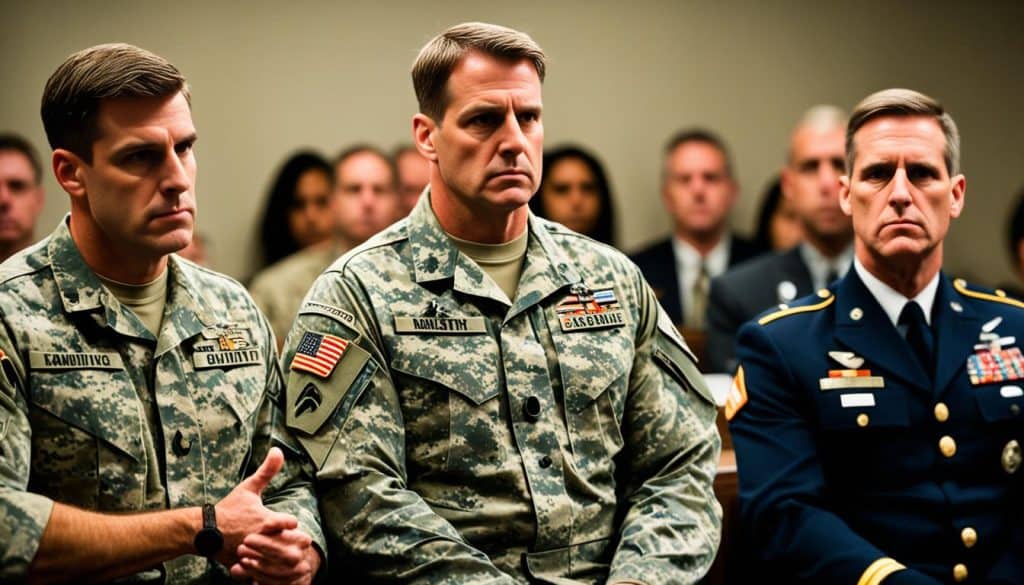
The military court-martial system is currently being debated, especially about whether verdicts should be unanimous. Unlike civilian courts, military courts don’t need every jury member to agree for a conviction. Instead, only three-quarters need to agree, according to the Uniform Code of Military Justice (UCMJ). This difference has sparked a lot of talk about whether the military justice system is fair and effective.
Current Military Jury Verdict Standards
In a general court-martial, a verdict is reached if three-quarters of the jury, which is usually six to eight members, agrees. This means a service member might be found guilty even if up to two members think they are innocent. This is very different from civilian courts, which require a unanimous verdict for guilt. It leads to questions about the fairness of the military justice system.
Recent Court Rulings and Their Implications
A recent key decision by the U.S. Court of Appeals for the Armed Forces in U.S. v. Anderson reinforced the non-unanimous verdict standard with a 5-0 ruling. This shows the military court’s commitment to its traditions. However, it also continues the debate over service members’ rights and the integrity of the justice system.
Prospects for Future Legislative Changes
The House of Representatives made a move in 2023 by passing a bill requiring unanimous verdicts in courts-martial, but it didn’t get through the Senate. The House’s version of the 2024 defense policy bill now asks the Pentagon to report by March 2024 on implementing unanimous verdicts. This shows Congress’s interest in making military trials more like civilian ones to be fairer. However, with the Supreme Court only looking at a few military law cases each year, big changes might be hard to achieve.
The debate over requiring unanimous verdicts in courts-martial highlights important issues about service members’ rights and justice fairness. How this debate ends could significantly change military justice, possibly leading to major reforms.
Military Law and Its Unique Challenges for Service Members
The military legal system poses special challenges for those in service. It’s a different world, with its own rules, known as the Uniform Code of Military Justice (UCMJ). This system must balance discipline with preserving individual rights.
 The Supreme Court often trusts the military’s judgment in legal matters. This trust means the military can set rules that wouldn’t work outside military life. During the Vietnam War, important cases highlighted how strict the military can be.
Rules on personal behavior and beliefs also show the military’s unique position. “Don’t Ask, Don’t Tell” is one example of trying to balance military needs with personal rights. Yet, service people have less freedom in some areas than civilians do.
Military legal processes range from simple to complex. Minor wrongdoings may get nonjudicial punishments. Serious crimes face court-martials, with a judge and jury-like panel. This layered system shows the effort to be fair while ensuring discipline.
The Role of Military Judges: Duties and Responsibilities
Military judges are crucial in keeping military trials fair. They have many duties to ensure justice is rightly served. With great power, they must always be fair in their decisions.
Authority and Discretion in Military Court Proceedings
Military judges have a lot of power in court-martial cases. They teach panel members about punishments as per the Manual for Courts-Martial. They also explain special defenses and manage the trial proceedings.
Ensuring Fairness and Justice in Plea Inquiries
During plea inquiries, military judges make sure guilty pleas are based on facts and law. They inform the accused about how punitive discharges can affect retirement benefits. They pay close attention to objections, which are crucial.
Technological Intersections and Expert Testimonies
Today, military judges face challenges with technology in law. They assess technology evidence’s importance and truth. Often, they depend on experts to understand complicated info.
As law interpreters, they can declare mistrials or order continuations. They deal with legal disputes under the Uniform Code of Military Justice.
Proposed Military Law Revisions to Enhance Justice
It’s vital to keep updating military law to protect the rights of service members and improve justice. The new reforms aim to make big changes. For example, important cases like sexual assault and murder will shift from commanders to independent military prosecutors.
This big step is the most impactful change since the military justice system began in 1950.
The new plans include creating the Offices of Special Trial Counsel (OSTC). An Executive Order states that OSTC will make decisions on prosecuting serious crimes. This ensures that decisions are fair and not influenced by military commanders. These changes promote justice and fairness in military trials.
There’s also a focus on fixing how sentencing is done in courts-martial for rape and sexual assault. The goal is to make punishments fair and to have clear evidence rules for sexual misconduct cases.
The Defense Department is also hiring 2,000 experts for preventing such offenses. They’re working to make the team that handles sexual assault cases more professional. Policies now help more domestic violence survivors and ensure sexual harassment reports are checked independently. These steps show a deep commitment to making the military justice system better and safer for everyone.