Public Protests: Knowing Your Legal Rights

In May 2015, the ACLU of Illinois shared a report about Chicago’s protest history. It shows how the First Amendment protects our protest rights. This document is like a guide for understanding our civil rights during demonstrations.
We all have the right to protest, whether we’re citizens or not. This freedom is protected by the First Amendment. But, the government can set some limits on this right. Knowing the rules about public protests can help keep you safe when you speak out.
Knowing your legal rights is key to a safe protest experience. Whether you’re joining a protest or just want to know more, understanding these rights is important. It can help you avoid legal problems at demonstrations.
Key Takeaways
- The First Amendment protects the right to demonstrate and protest in public spaces.
- Government officials can enforce narrow restrictions on speech rights, so understanding these is essential.
- Legal aid should be sought in cases of rights violations or legal challenges during protests.
- Non-citizens have rights but must be cautious about the immigration implications of participation in protests.
- Police officers are expected to exercise restraint, even if verbally abused by protesters.
Your First Amendment Rights
The First Amendment of the United States Constitution protects our civil liberties. It allows us to speak freely without interference. It’s a key part of American law.
It even covers the right to gather peacefully. Recently, groups like Black Lives Matter and Occupy Wall Street have held protests. These events show the power of First Amendment protections.
In 1961, the civil rights movement showed the importance of the right to protest. Despite arrests, these protests against unfair treatment made a difference. Activists used nonviolent ways, like sit-ins, to oppose segregation.
The government can’t limit speech based on its content. But there are some limits, like bans on obscenity and calls to violence. Laws are made to keep the public safe and maintain order, without curbing our freedoms.
Protesting on Public Property
Public property is a common spot for free speech and assemblies. Knowing your rights during free speech on public land is crucial. It ensures you follow the law and protest effectively.
Traditional Public Forums
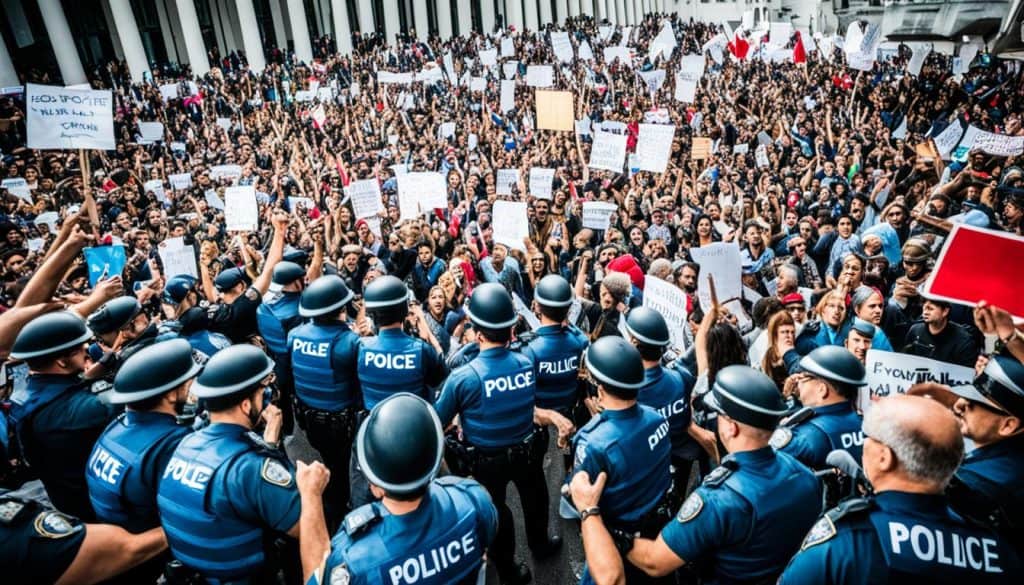
Places like streets, sidewalks, and parks are key for free society, as the Supreme Court says. They are perfect for demonstrations. Here, you can speak out without needing approval, as long as you don’t block traffic or people walking. The role of public protests has always been vital in pushing for change.
Your Rights on Streets, Sidewalks, and Parks
Your right to gather on streets, sidewalks, and parks is supported by strong legal precedents. Protests in these places are a form of free speech, protected by the First Amendment. But, it’s important to follow rules to keep things orderly. The government can set limits on protests’ time, place, and manner. But these limits must be fair and not based on the protest’s viewpoint. You might need a permit for big events or to use loudspeakers, but your right to assemble is usually protected.
The government must demonstrate a “compelling need” for limiting protests in traditional or designated public forums.
By understanding your rights and duties during protests, you can make your voice heard legally and effectively.
Protesting on Private Property
Understanding the difference between public and private property is key when planning a protest. Public spaces generally allow more freedom for protests. On the other hand, private property rights mean owners can set their own rules.
Limitations Imposed by Property Owners
Owners of private property can decide what’s allowed on their land. They can ban certain types of signs, speech, or groups that don’t follow their guidelines. If these rules are broken, the owners can enforce trespassing laws, leading to protesters being asked to leave or facing legal actions.
Possible Consequences and Legal Implications
Protesting on private land without permission can have big legal consequences. Trespassing is a typical charge faced when protestors don’t leave as asked. Worse cases can see individuals arrested based on property law. Considering the impact of these actions is important as they can lead to fines, criminal records, or deportation for those not from this country.
While it’s great to stand up for what you believe in, it’s crucial to respect private property rights. Knowing the risks helps balance the need to protest with the need to follow the law.
Permits for Public Protests
Getting protest permits is key to making sure your protest follows the law. In Washington, D.C., permits are handled by three groups: the United States Park Police, U.S. Capitol Police, and Metropolitan Police of the District of Columbia. It’s important to know legal requirements for protests where you plan to demonstrate.
Permits are often needed for big groups, organized marches, or events needing loudspeakers. With a permit, organizers can plan out details and avoid breaking laws or safety rules.
But, it’s important permits don’t stop quick action for sudden important issues. Being able to protest quickly is important and permits shouldn’t get in the way of that.
- Protests are protected by the First Amendment, which is essential for democracy.
- The government can set rules based on time, location, and how a protest is run, not on what protesters say.
- Streets, sidewalks, and parks are key places for protests, where rights are very strong.
Police must treat all protesters the same, which is fair. Filming or taking photos of police at protests is also a right under the First Amendment.
Restrictions on Time, Place, and Manner
Although the First Amendment supports the right to protest, constitutional restrictions can set nondiscriminatory limits. These limits are for the time, place, and manner of public protests. They help keep everyone safe and make sure protests don’t stop others from having their rights.
Non-Discriminatory and Narrowly Drawn Restrictions
In cities and counties, it’s normal to see limits on when and where protests can happen. To meet First Amendment standards, these limits must pass a three-step test from Ward v. Rock Against Racism (1989). They should be neutral, narrowly focused to serve a governmental interest, and allow different ways to communicate.
In Police Department of Chicago v. Mosley (1972), the court said no to rules that weren’t neutral. Thus, a rule must treat all messages the same. Courts usually agree with restrictions that don’t completely ban protests or offer no other way to express the message.
What Are Reasonable Restrictions?
Reasonable limits allow people to share their message without causing traffic or public safety issues. For instance, Chicago sets rules on loudspeakers to prevent noise beyond conversational levels from afar, except for events like parades. These rules aim to avoid chaos while allowing free speech.
In Million Youth March, Inc. v. Safir (S.D.N.Y. 1998), a decision said not having other ways to speak out broke the First Amendment. So, fair rules should let protesters share their thoughts without hurting public needs. Time, place, and manner limits judged by courts have to meet a stricter test than those made by lawmakers.
Keeping public safety regulations and First Amendment rights in balance is tricky but vital. By making sure rules are fair and non-biased, we support democratic expression and everyone’s safety.
Financial Requirements for Protests
Holding public protests is key to using First Amendment rights. But, facing costs can be tough. Local governments often charge fees for security and safety. This makes it hard for grassroots organizations with less money to participate.

It’s critical for rules to allow for fee waivers or reductions. This helps grassroots organizations overcome money barriers to protest. Without such options, groups pushing for change may not manage the costs.
In Chicago, there’s a rule for when you need a protest permit. If news breaks and you respond right away, you’re exempt. Certain event planners must get $1,000,000 in insurance. Yet, if it’s too costly, there’s an exemption, allowing small groups to speak out.
Laws also say government fees on protests can’t be more than actual costs. It’s crucial to keep this fair and open. There must be allowances for groups that cannot afford these fees. This protects their protest rights.
Public Protests and Counter-Demonstrators
Public protests often see the presence of counter-demonstrators. Both exercise their right to free speech. Keeping protests safe and orderly is key to letting all voices be heard. It prevents tensions from rising.
Managing conflicts well and knowing the rights of counter-demonstrators are crucial. This helps everyone coexist peacefully during such events.
Rights and Limitations of Counter-Demonstrators
Counter-demonstrators can oppose and be present at protests. But, they should not disrupt the main protest physically. This balance helps keep public order. It allows both sides to share their views near each other.
Managing Conflicts Between Groups
Keeping public protests safe requires good conflict management. Sometimes, police need to step in to keep groups apart and avoid fights. Yet, they should let both sides stay close to express their views. This way, everyone’s rights are respected.
For personal safety at protests, demonstrators should keep a few tips in mind: stay six feet apart if possible, have a buddy, and share your location with friends. Being aware of your surroundings and keeping your hands free are also smart moves.
Steps to Take if Your Rights Are Violated
If your rights are violated at a public protest, knowing what steps to take is key. Start by documenting everything. Use your smartphone to take photos or videos. Focus on any wrong actions by the authorities. This proof is very important when you make your complaint.
Then, try talking to the person in charge right there. Explain your concerns clearly and calmly. Mention specific times when your rights were ignored. Sometimes, this can fix the problem without needing to go to court. If talking doesn’t work, reach out to groups like the American Civil Liberties Union (ACLU) or the Foundation for Individual Rights in Education (FIRE). They are experts in protecting your rights.
You might have to make a formal complaint next. Talk with a civil rights lawyer to figure out the best action to take. In cases where the police used too much force, you could sue. This has been happening more since the early 2000s. Lawsuits can push for new rules and better control to stop this from happening again.
Dealing with authorities today is tricky because they use high-tech surveillance at protests. Organizations like Amnesty International are fighting against the use of standard police gear in a wrong way. They want to stop the use of harmful tools at protests. By staying informed and active, you help protect your rights. You also help make public protests safer and fairer for everyone.where surveillance technologies, such as facial recognition and tracking software, are increasingly used during protests. Organizations like Amnesty International highlight the misuse of standard police equipment, and ongoing campaigns aim to ban harmful protest control tools. By staying informed and proactive, you can protect your rights and contribute to broader efforts to ensure safety and fairness in public demonstrations.